01
Unexpected Increase
“Why is my bill suddenly higher?”
Understand the cause
A research-driven approach to understanding what customers are trying to accomplish, not just what they clicked.
Customer intent is the goal a customer is trying to accomplish in a specific moment, context, or journey. It may be expressed directly or suggested by signals, but it should not be treated as known unless supported by evidence.
What the customer said, searched, clicked, selected, or did.
The customer goal that may sit behind the observable signal.
The reason accomplishing that goal matters to the customer.
The state that indicates the customer has successfully moved closer to—or achieved—the goal.
Intent is not the behavior itself. Intent is the purpose the customer is attempting to advance through that behavior.
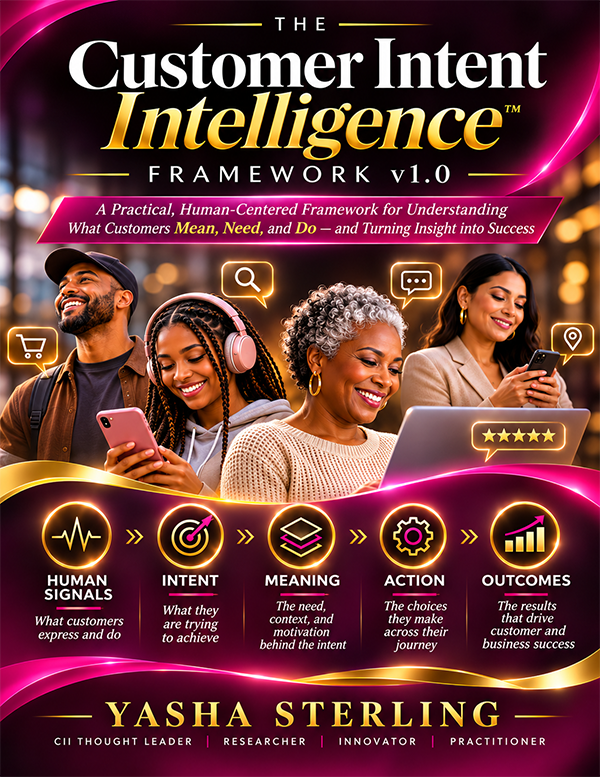
From customer signals to better-supported decisions and measurable outcomes.
The Customer Intent Intelligence™ Framework introduces an evidence-first method for investigating what customers may actually be trying to accomplish—without confusing behavior, inference, or AI-generated interpretation with validated intent.
Customer Intent Intelligence separates the observable signal from the customer goal it may—or may not—represent, then investigates the evidence before the organization decides how to respond.
We can measure what people do. But understanding what they are trying to accomplish requires context, evidence, and careful interpretation.
Read Behavior Is Not Intent ↗Customer Intent Intelligence™ investigates possible customer goals, motivations, decision trade-offs, and confidence needs by examining behavioral signals alongside direct customer evidence.
It distinguishes what we observe from what we infer—and asks what evidence would support or challenge our interpretation.
One Query. Five Possible Goals.™
Google can help surface the question. But the same search can represent very different customer goals. Customer Intent Intelligence™ helps the organization investigate what the customer may actually be trying to accomplish—and what evidence supports that interpretation.
“Why is my bill suddenly higher?”
Understand the cause“I can’t afford this right now.”
Find immediate help“I think something is wrong.”
Verify the bill“How do I lower this next month?”
Reduce future costs“I just moved. Is this normal?”
Understand new costsSearch intent helps classify the query and improve discovery.
CII investigates the possible goal, the context that changes its meaning, the evidence needed to validate it, and the next action that would actually help.
What is this customer actually trying to accomplish— and what evidence supports that interpretation?
Five connected intelligence capabilities offer a way to examine how organizations move from observing customer behavior to making better decisions and measuring value.
Explore the full model →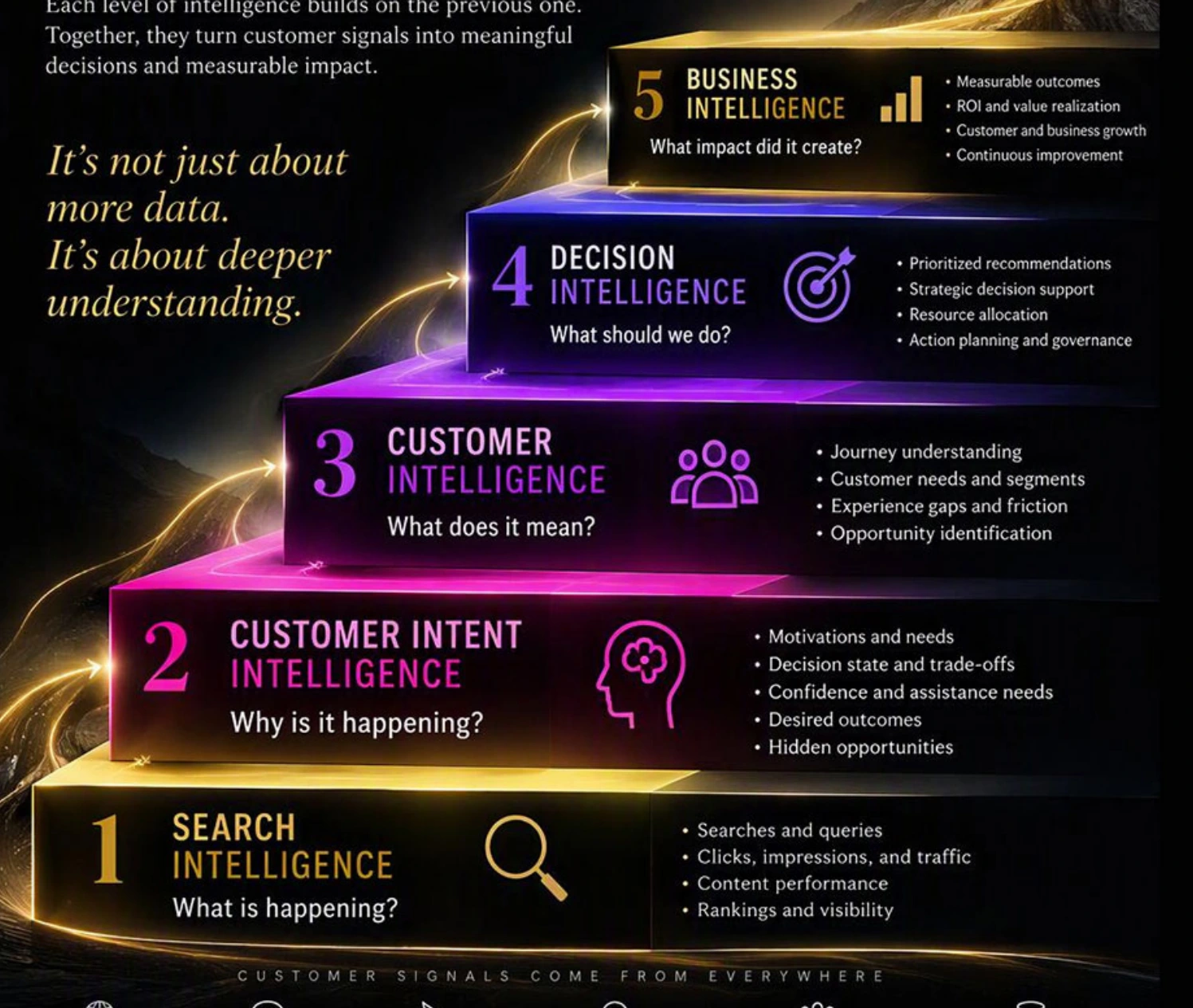
Choose a level to view its role and the questions organizations should investigate.
Customer Intent Intelligence™ provides a structured reasoning discipline for moving from observable customer signals to better-supported decisions and measurable outcomes.
The five-stage method makes interpretation, evidence, decision logic, and customer outcomes more visible.

What do we actually know happened?
Capture the customer signal and its context before assigning meaning. Separate what was directly observed from what is being interpreted.
What might the customer be trying to accomplish?
Develop multiple plausible customer-goal hypotheses rather than collapsing uncertainty into one assumed intent too early.
What evidence supports or contradicts that interpretation?
Examine supporting evidence, contradictory evidence, missing information, and viable alternative explanations.
What action is justified by what we currently know?
Match the strength of the organizational response to the strength of the evidence, consequence, authorization, and reversibility.
Did the action actually move the customer toward the intended outcome?
Measure customer resolution, correction, repeated effort, escalation, and intent drift—not organizational completion alone.
“What is this customer actually trying to accomplish — and what evidence supports that interpretation?”
The CII Manifesto articulates a commitment to more human-centered, evidence-informed customer understanding and accountable enterprise decision-making.
Read the Manifesto →“Better questions lead to better understanding. Better understanding can lead to better decisions.”— Yasha Sterling
Explore the developing evidence base through research insights, evidence reviews, whitepapers, and scholarly analysis of customer intent, decision-making, AI, and enterprise intelligence.
Read Behavior is Not Intent →Use practical guides, checklists, prompt libraries, and workflows to apply Customer Intent Intelligence to real work.
Explore Intent to Innovate ↗A 10-checkpoint, evidence-based review for identifying where a customer journey may diverge from the customer’s actual goal.
Evidence-first prompts for investigating customer intent, challenging assumptions, identifying evidence gaps, and making better decisions.
A practical roadmap for moving from Behavioral Intelligence to evidence-backed Intent Intelligence.
Move beyond explanation. Use interactive diagnostics, assessments, and simulations to examine customer-intent alignment, enterprise intelligence capabilities, journey friction, and potential outcomes.
Adjust real journey assumptions, watch the business opportunity change, and see the customer experience transform as CII maturity increases.
Examine enterprise capabilities across five intelligence disciplines and document the evidence behind each rating.
Investigate where a specific customer journey may diverge from the customer’s possible goal—and what evidence should be reviewed next.
Compare a possible customer goal with the organization’s response and see where alignment, friction, and evidence gaps may emerge.
The Intent Ledger examines how customer-intent intelligence could inform enterprise choices. Each case separates what is observed from what is inferred and what a team might decide to test.
Observed facts→Competing explanations→Intelligence needed→Possible decision implications
This fictional example illustrates the case format. It uses no real customer data or claimed organizational results.
In this hypothetical journey, a visitor returns to an eligibility page, opens requirements information, and leaves before beginning an application.
The visitor may be checking eligibility, gathering documents, comparing options, or encountering unclear requirements.
Compare search terms, journey analytics, customer feedback, support themes, and task research before deciding which explanation is best supported.
Test clearer eligibility and document guidance, then measure whether customers can complete the next intended task.
Explore interpretation, scholarly discussion, and personal reflection connected to Customer Intent Intelligence. These perspectives complement the research library; they are labeled by type and are not presented as peer-reviewed findings.
Evidence-first critiques of the claims shaping AI, search, analytics, automation, and customer intelligence.
Research-informed examinations of customer intent, AI, evidence, information systems, and enterprise decision-making.
Personal reflections on research, AI, evidence, leadership, and how doctoral study is reshaping the way I think about Customer Intent Intelligence.
A perspective on search intent, customer understanding, and how organizations interpret signals.
Better questions can lead to better experiences—and more meaningful outcomes.
Return to the beginning ↑