Behavior Is Not Intent.
Observed behavior can support an interpretation. It should not automatically be treated as the customer's goal.
An evidence-first method for moving from customer signals to better-supported decisions and measurable outcomes. CII gives organizations a disciplined way to distinguish what customers did from what they may actually be trying to accomplish.
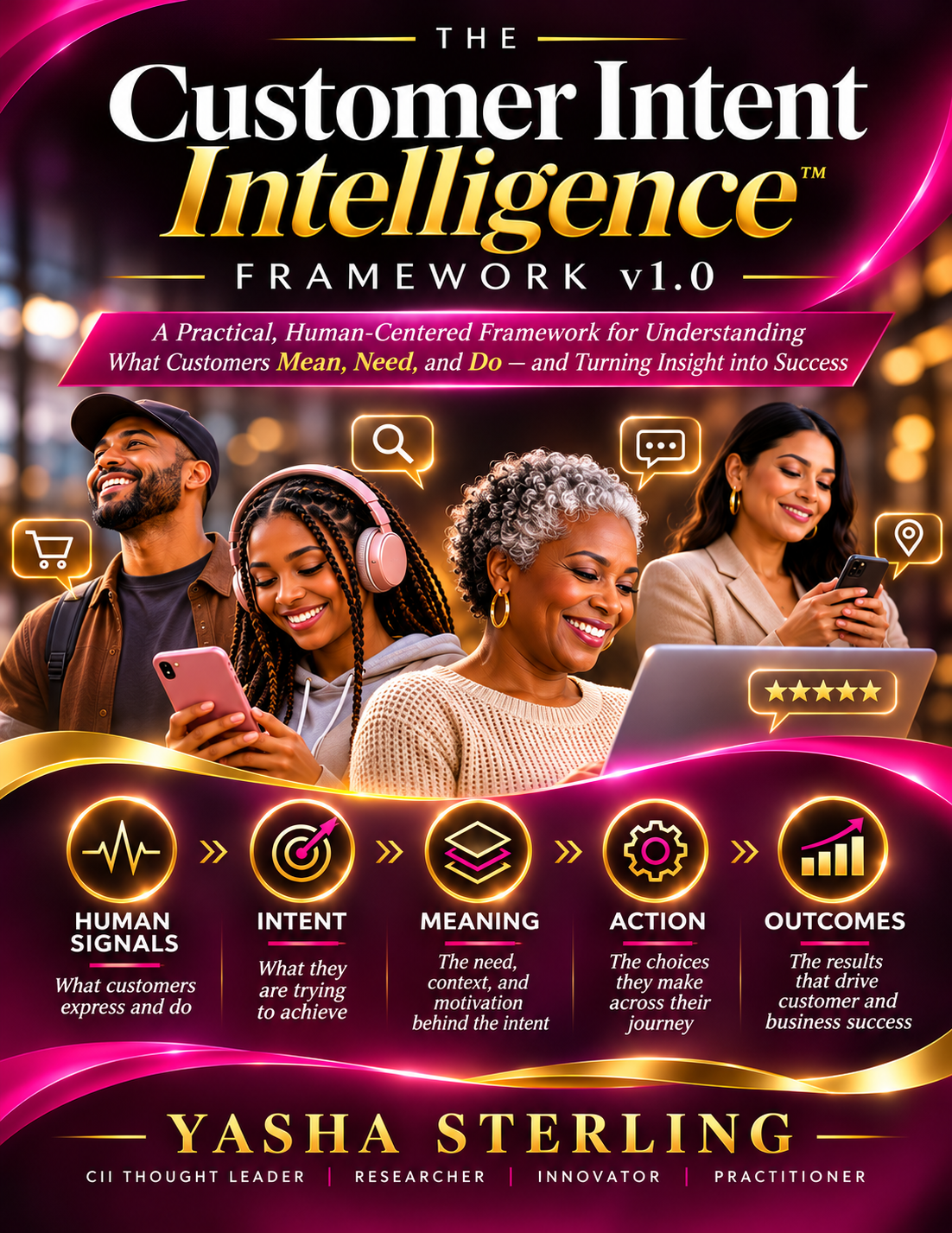
Organizations can observe searches, clicks, transactions, conversations, journeys, and AI interactions at extraordinary scale. CII addresses the gap between the signal that is visible and the goal the customer may actually be trying to accomplish.
A customer searches:
Customer intent is the goal a customer is trying to accomplish in a specific moment, context, or journey. It may be expressed directly or suggested by signals, but it should not be treated as known unless supported by evidence.
What the customer said, searched, clicked, selected, or did.
The possible customer goal sitting behind the observable signal.
The reason accomplishing that goal matters to the customer.
The state that indicates the customer moved closer to—or achieved—the goal.
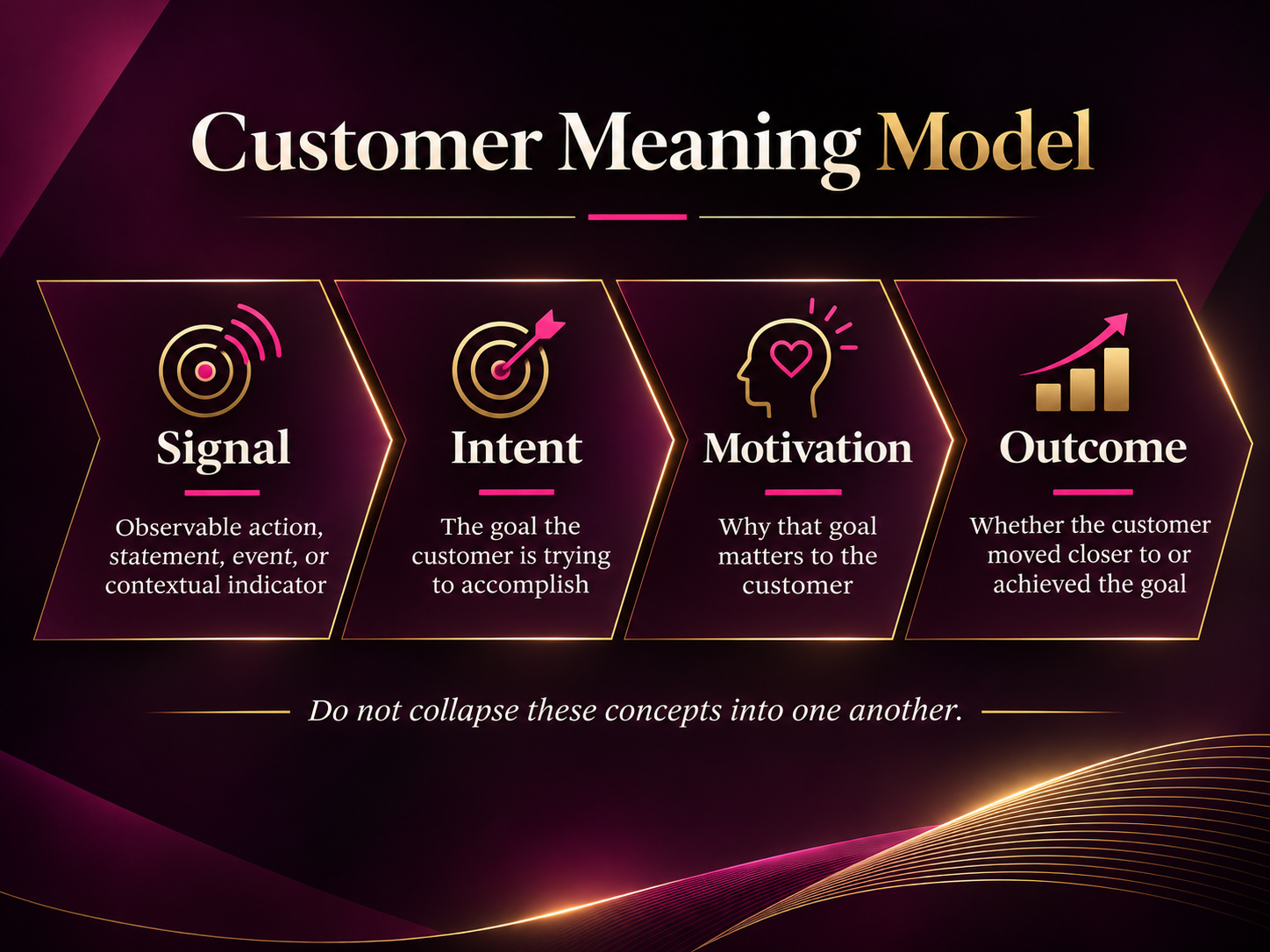

Capture the customer signal and its context before assigning meaning. Describe what happened, identify the source, preserve direct customer statements, and record what remains unknown.
Each principle prevents a different form of overclaiming—from confusing behavior with meaning to confusing execution with customer success.
Observed behavior can support an interpretation. It should not automatically be treated as the customer's goal.
A plausible interpretation does not become evidence merely because a model, AI system, or practitioner produced it.
An agent's execution reflects an interpretation. The execution itself does not validate what the customer meant.
A response can fit a hypothesized goal beautifully while the hypothesis remains weakly supported.
Better communication is useful. Customer success requires evidence that the goal was actually advanced.
CII operationalizes interpretation through three mechanisms that preserve uncertainty, evidence, and competing explanations.
Creates traceability from signal to hypothesis to action to outcome.
Communicates how well the customer-goal hypothesis is currently supported.
Keeps meaningful alternative explanations visible until evidence reduces the ambiguity.
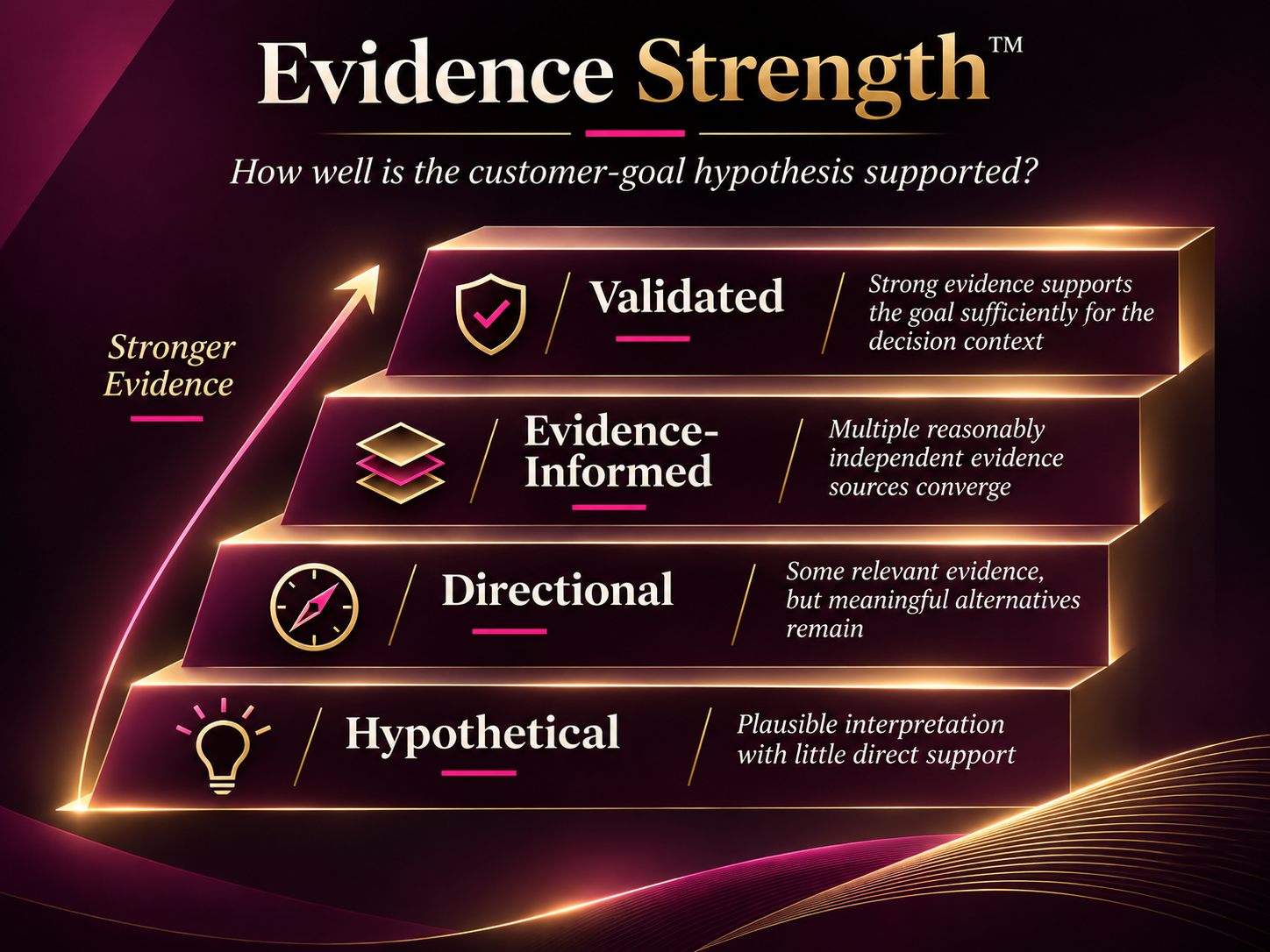
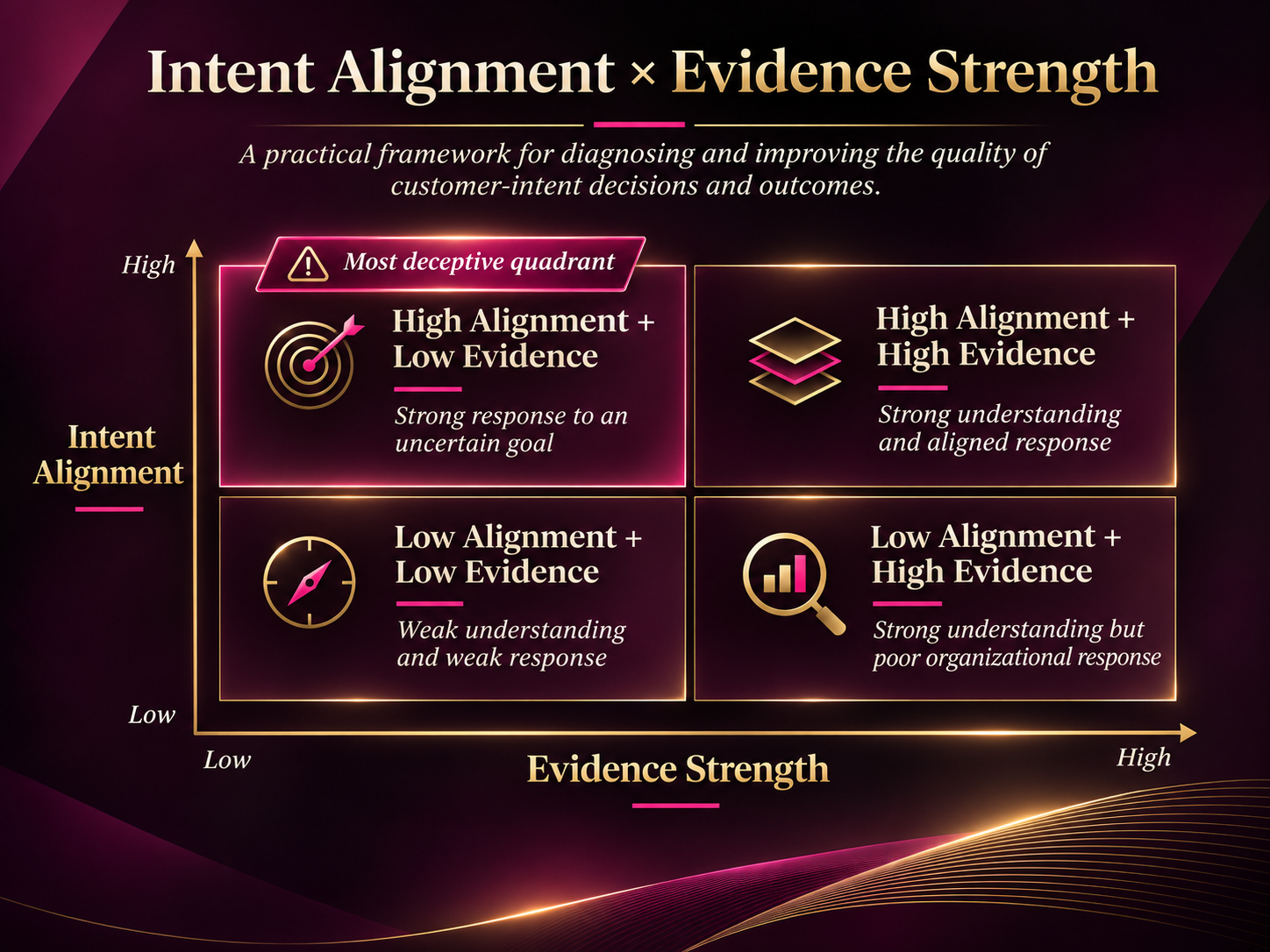
As AI moves from recommending to acting, the cost of weak intent interpretation increases. CII adds an evidence-first reasoning layer before and around authorization.
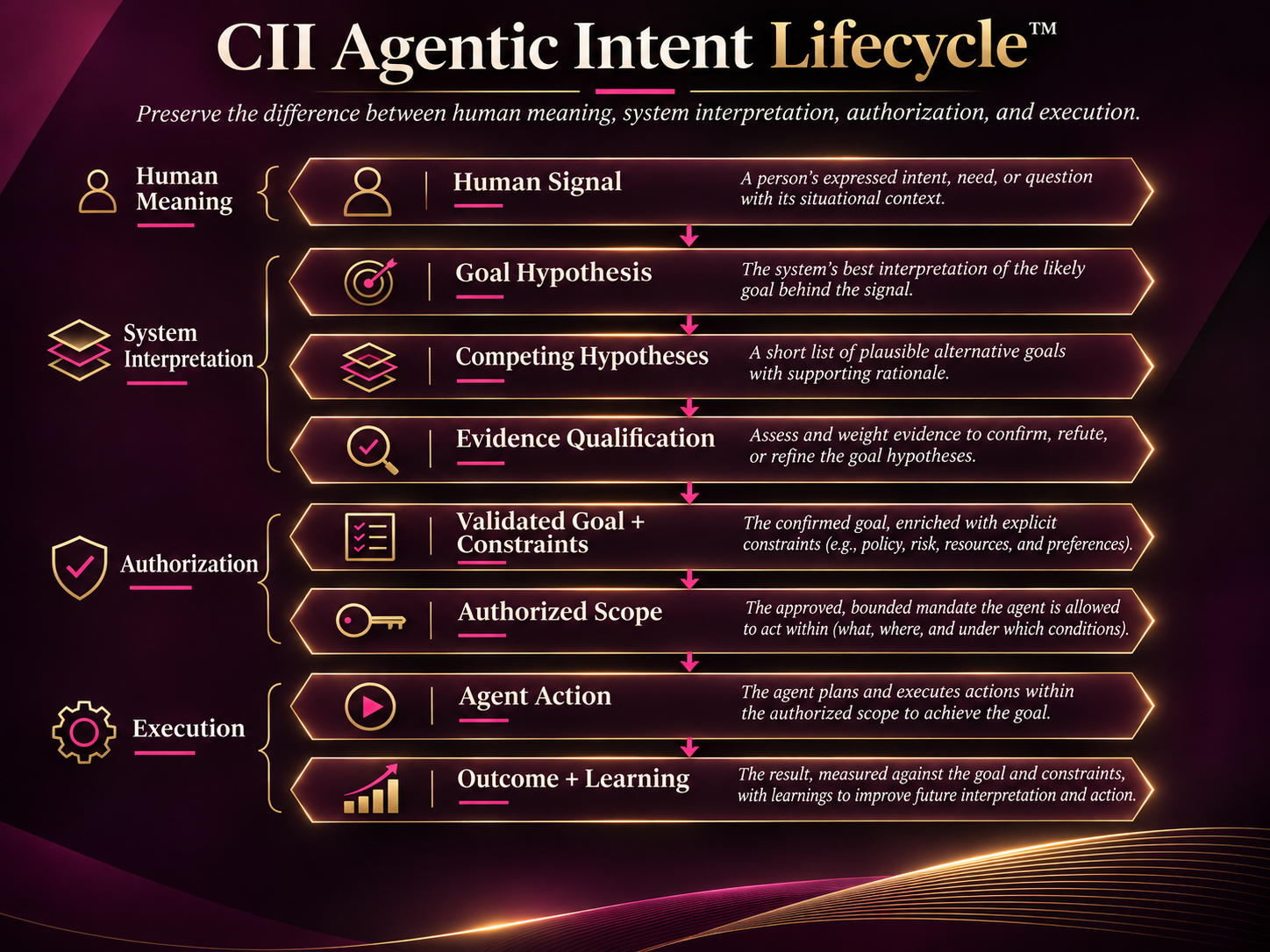
Agentic systems should distinguish human signal, system interpretation, validation, authorization, execution, and outcome. A verified agent can still misunderstand the customer.
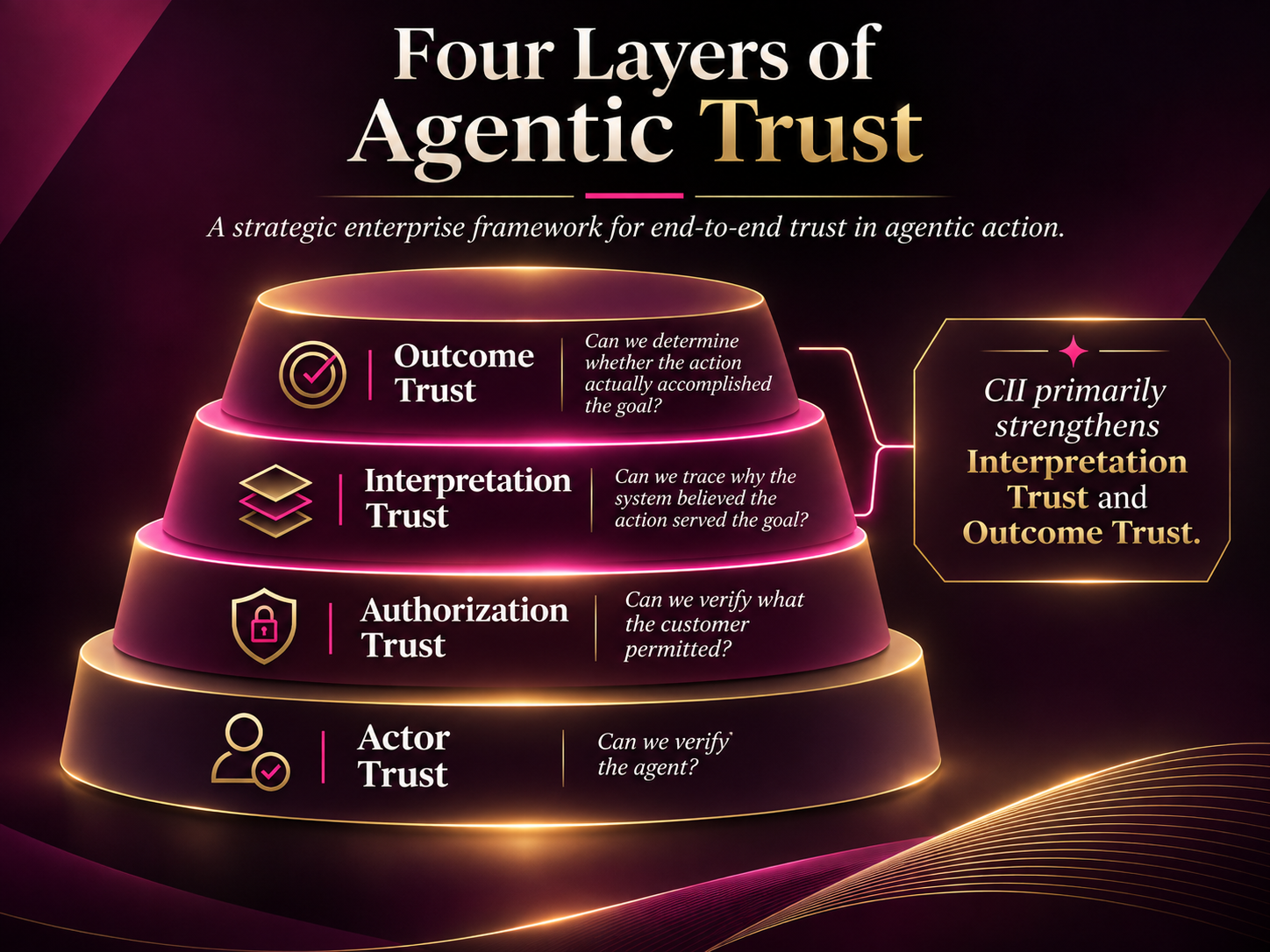
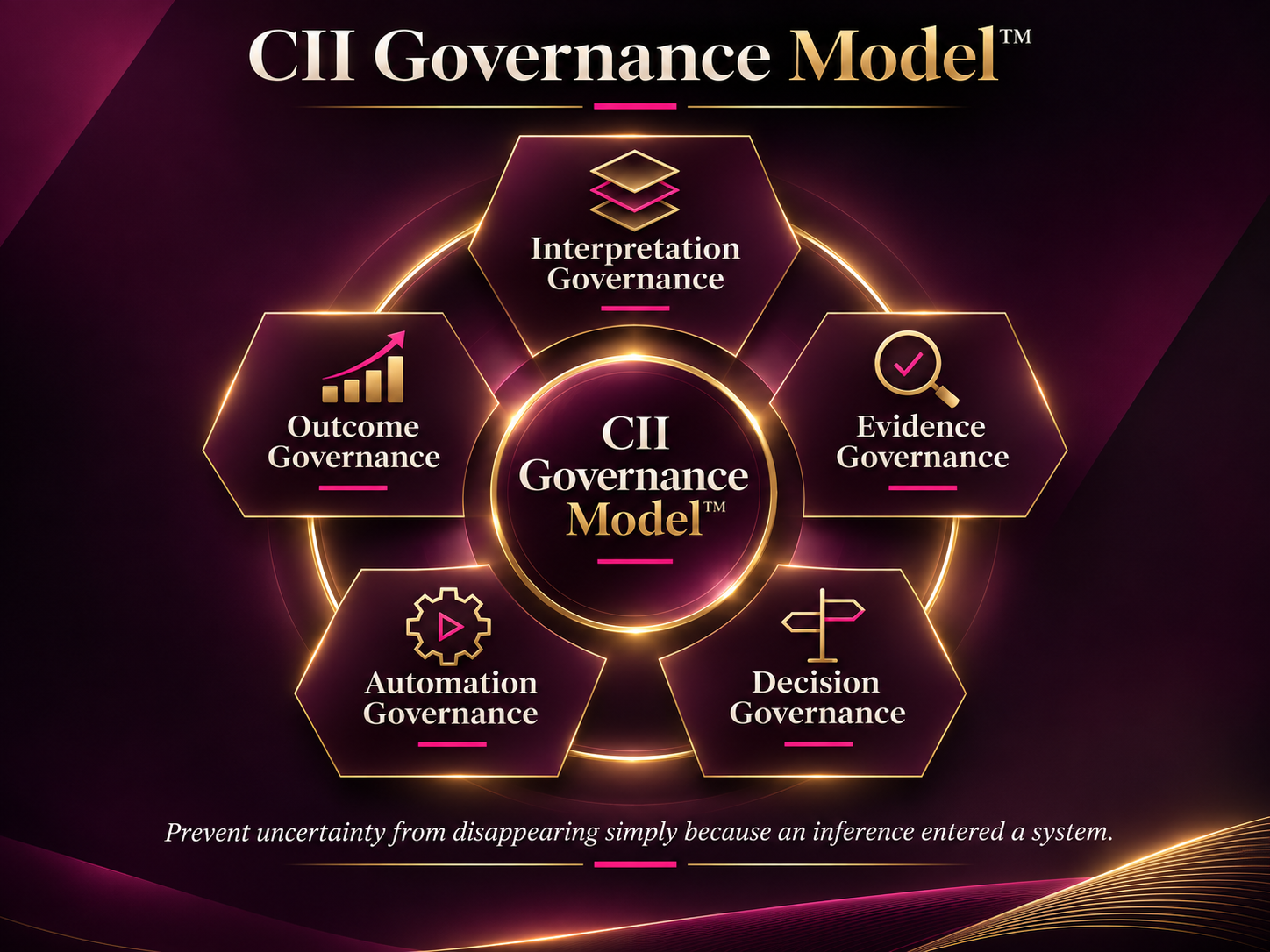
Search can retrieve. AI can answer. Journeys can route. Content can persuade. Enterprise systems can coordinate. CII asks whether each is serving the customer goal the evidence actually supports.
Move from query classification toward Search-to-Goal interpretation.
Recognize ambiguity, clarify when necessary, and reduce fluent misalignment.
Design pathways around customer goals rather than organizational structure.
Ask not only “Is this clear?” but “Clear for what customer goal?”
Preserve signal provenance, hypotheses, evidence state, and outcomes across systems.
IntenSight™ is a standalone Intent Alignment Intelligence platform built on Customer Intent Intelligence™ principles. It is one commercial application of the theory—not the definition of CII.
Diagnose friction. Generate competing customer-goal hypotheses. Evaluate evidence. Reframe experiences. Validate before scaling.
Explore IntenSight →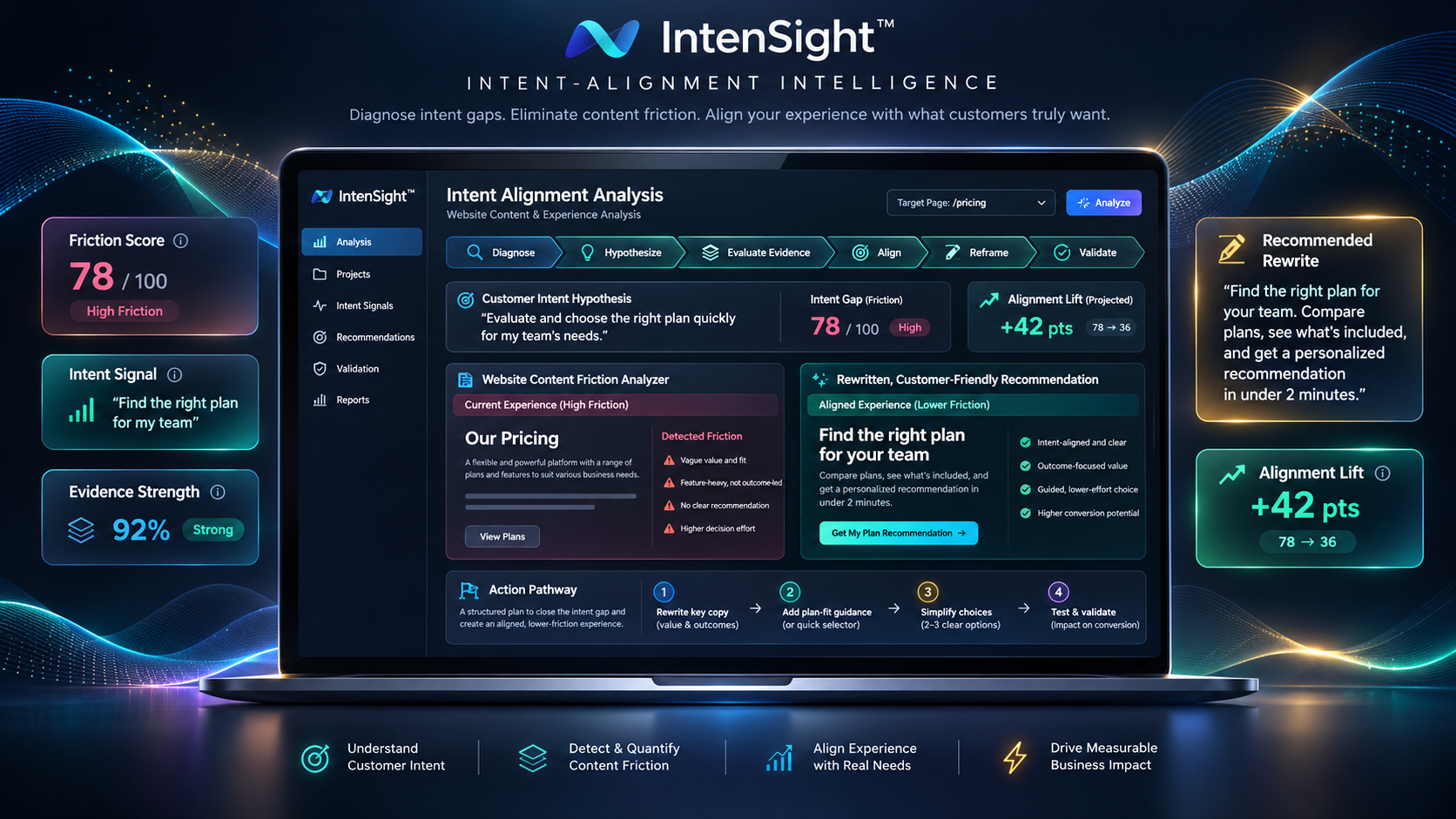
Framework v1.0 is intentionally connected to live demonstrations that show how the concepts behave in real customer-facing situations.
Choose a digital surface and watch CII maturity transform the experience.
Search LensOne query. Multiple possible customer goals.
Scenario SimulatorTest whether the response aligns to the possible customer goal.
Practitioner ToolFind where a journey responds to a different goal than the customer may be pursuing.
Commercial ApplicationSee CII principles operationalized as Intent Alignment Intelligence.
CII does not ask to be believed because it is well articulated. It makes its constructs explicit enough that practitioners and researchers can evaluate them.
Framework v1.0 establishes conceptual and operational constructs for continued empirical research.
CII explicitly makes uncertainty visible and scales decision authority to evidence, consequence, authorization, and reversibility.
Take Customer Intent Intelligence™ with you.
Use the complete framework, quick reference, citation guidance, or five-stage visual depending on how you want to apply, teach, reference, present, or share CII.
The complete methodology for moving from customer signals to better-supported decisions and measurable outcomes.
Explore the five-stage CII method, canonical definitions, core principles, Evidence Strength™, competing hypotheses, agentic applications, governance model, research agenda, and guidance for applying the framework across customer-facing systems.
A one-page companion covering the canonical definition, five-stage method, core principles, Evidence Strength™, reasoning chain, and central CII question.
Use the recommended citation, in-text reference, canonical definition, and standardized language when referencing Customer Intent Intelligence™.
A presentation-ready visual showing the complete Customer Intent Intelligence™ reasoning sequence.
Customer Intent Intelligence™ is designed to improve the connection between what customers signal, what organizations believe, what organizations do, and what customers ultimately accomplish.